I didn’t expect to stop for long.
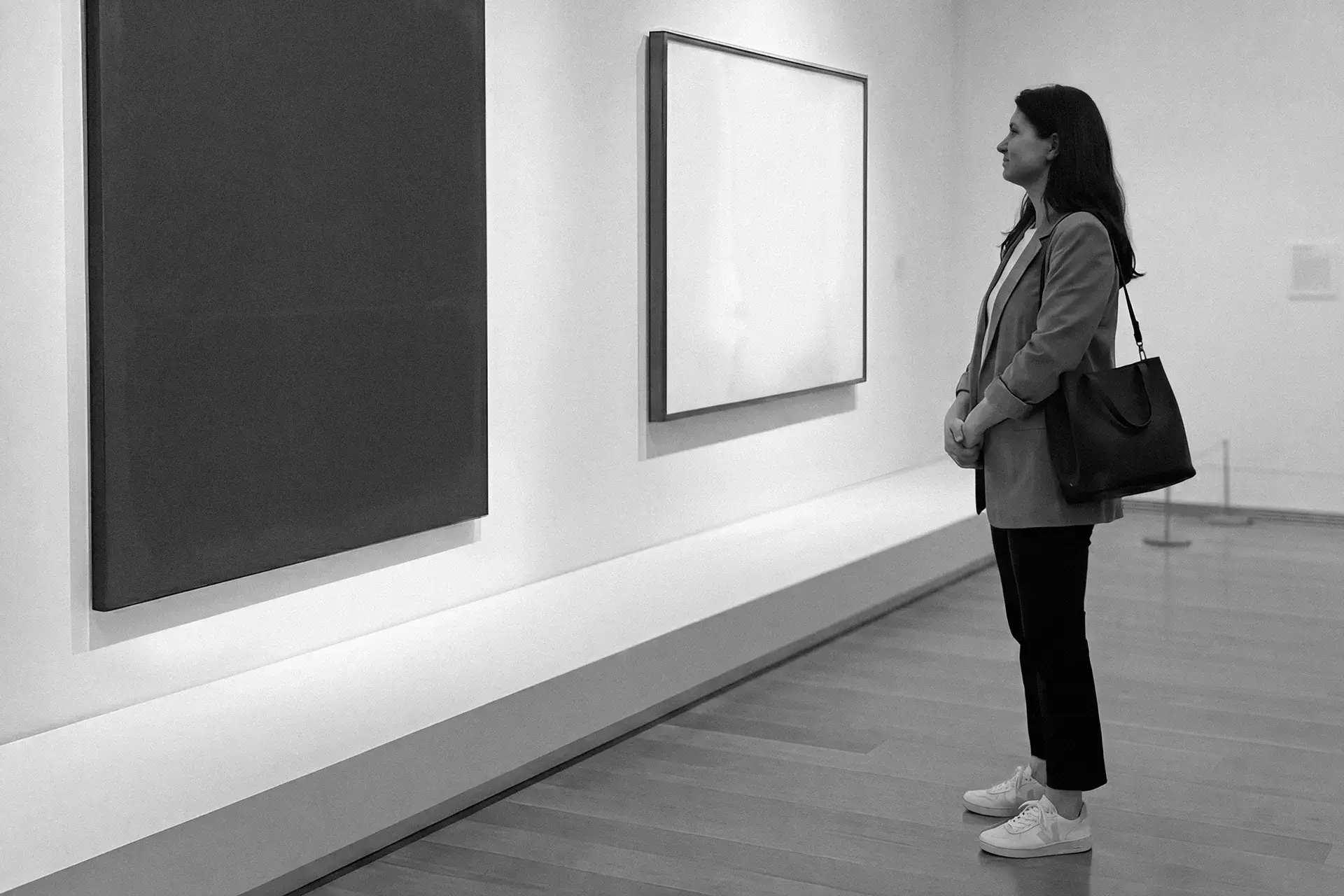
Untitled (1960) by Mark Rothko doesn’t give you much to hold onto at first – it reads almost as a dark surface, the colour only beginning to emerge after a few moments. Then it becomes difficult to leave.
I had come across the work while visiting the Auckland Art Gallery Toi o Tāmaki, where it was part of Pop to Present: American Art from the Virginia Museum of Fine Arts. Surrounded by works that offered something more immediate – recognisable imagery, clearer points of entry – Rothko’s painting felt different. It didn’t present itself in the same way.
Staying with the painting
Standing a few steps back, the shift is gradual. The surface – those hovering bands of colour – carries a weight that doesn’t resolve into anything neat.
It isn’t comforting, but it isn’t hostile either. It sits somewhere more complicated, asking for a kind of attention that feels almost unfamiliar.
There’s a tendency to describe his work as simple – rectangles, soft edges, colour. From a distance, that description holds. But up close, the surface begins to shift. The colour isn’t flat; it breathes. Edges dissolve rather than define. The painting feels less like an object and more like a field you enter. And once you’re in it, the usual ways of reading an artwork start to fall away.
There’s nothing to decode in the conventional sense. No figures, no symbols to anchor interpretation. Instead, the questions turn inward – what am I feeling here, and why? Those aren’t questions you answer quickly. They stretch.
Give the painting ten seconds, and it offers very little. Give it ten minutes, and something begins to shift. Not dramatically, but enough to register. A colour deepens. A boundary softens. A feeling you couldn’t quite place settles into something more recognisable, even if it remains just out of reach.
I noticed myself adjusting – not consciously, but physically. The urge to move on softened. The distance between my body and the painting narrowed. I wasn’t looking for detail. I was staying with it.
A different kind of attention
It became clear that he isn’t giving you an image to consume. He’s creating a condition you inhabit.
I had read that Rothko was associated with Abstract Expressionism – a group of American painters who had already moved away from depicting the world directly.
But standing in front of his work, it felt quieter than I expected – less about gesture or energy, more about something internal and sustained.
Earlier forms of abstraction had already loosened the connection between image and object. Rothko seems to take that further, removing almost everything that might guide you. What remains is very simple – blocks of colour, soft edges – yet the experience of looking is anything but simple.
That distinction feels sharper now than it might have decades ago. We move quickly through images, registering and discarding them almost in the same motion. Rothko’s paintings sit against that current. They don’t offer themselves easily, and in doing so, they recalibrate your pace.
It’s tempting to frame this as a rejection of certainty, but that misses something. Rothko doesn’t deny clarity – he relocates it. The clarity isn’t in what the painting depicts, but in the experience of staying with it. The longer you stand there, the more precise your own responses become. Not clearer in a factual sense, but more defined in how it feels.
Much of contemporary life pushes towards resolution. Rothko allows for something less settled but more grounded. You’re not asked to decide what the work is. You’re asked to notice what happens as you remain with it.
After stepping away
Walking through the rest of the exhibition after that encounter, I became aware of my own pace. The instinct to move quickly was still there, but it felt slightly out of step. Other works opened up differently when given more time, though few demanded it in the same way. Rothko doesn’t just hold your attention – he adjusts it.
Later, I found myself looking into his life. The trajectory felt unexpectedly familiar. Born in Eastern Europe, he emigrated to the United States as a child in 1913. The dislocation of that move feels close to the surface of the work. A shift in language, culture, identity – all before the work even begins.
It’s easy to draw a direct line from biography to painting, but that risks flattening both. Still, there’s something in that early experience – the sense of being between places – that echoes in the work. Not as a literal reference, but as a condition. His paintings don’t settle. They hover, they shift, they resist fixed positions.
That resistance holds its ground.
What stays
Not simply as an aesthetic choice, but as a way of engaging with a world that rarely offers clean edges. The ambiguity in Rothko’s work isn’t decorative. It mirrors something fundamental – the contradictions, the uncertainties, the moments that don’t resolve neatly.
Standing in front of his painting, that complexity doesn’t feel overwhelming. It feels held.
Leaving the gallery, it wasn’t the image that stayed with me. I couldn’t have described the painting in precise terms if asked. What lingered instead was a shift in tempo – a slowed rhythm of attention that carried beyond the room.
Not because it demands anything dramatic.
But because it asks you to stop – and stay there long enough for something to happen.