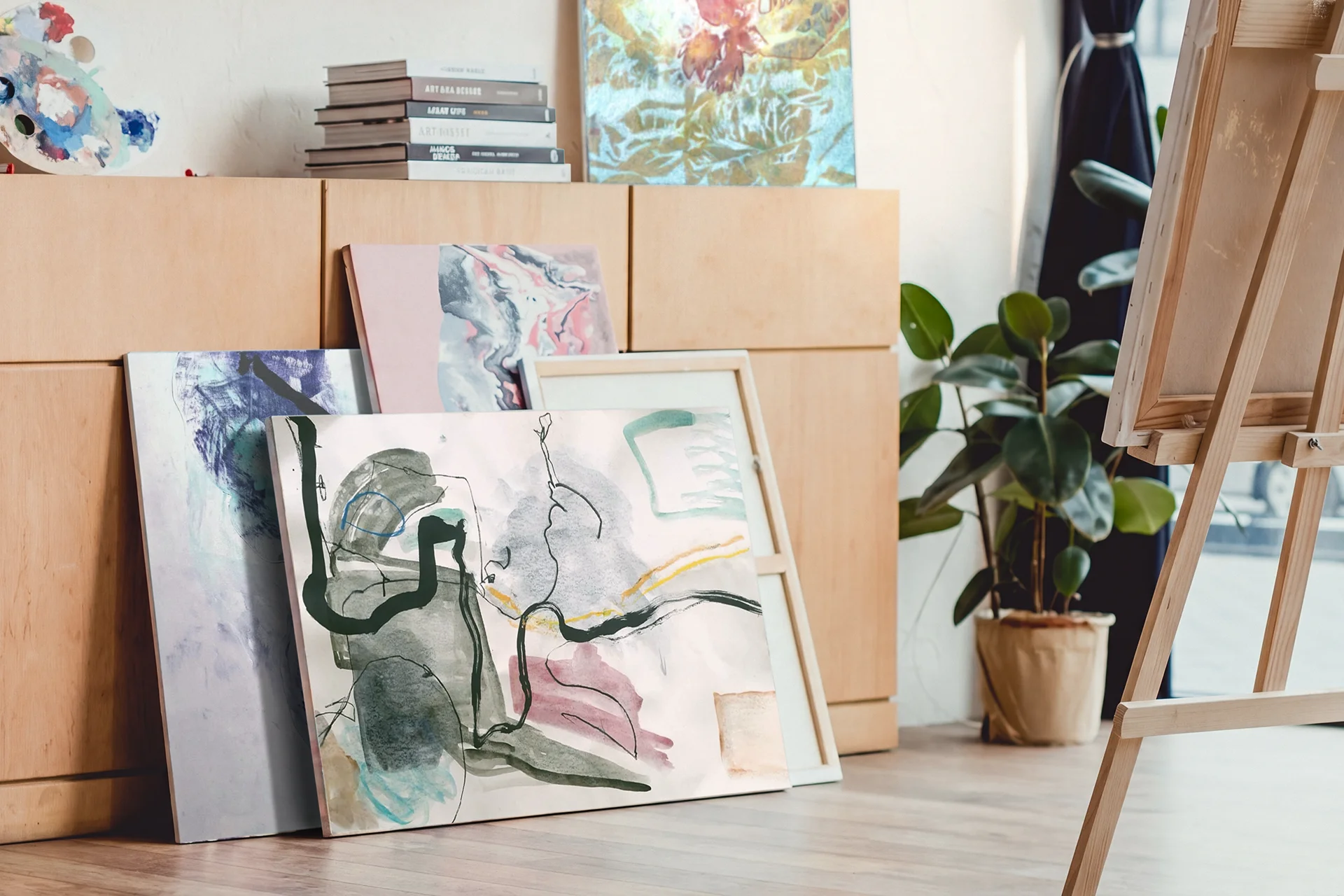
The painting had been set aside for weeks – not finished, not abandoned, just there in the studio. I wasn’t sure how to continue.
Each time I returned to it, the same thing happened. I knew what it was meant to be, but every attempt stalled, and nothing I added seemed to move it forward.
There’s a particular kind of frustration that comes at that point – when the work in front of you no longer matches the one in your head, and you can’t quite bridge the distance. It doesn’t quite feel like failure, more like a quiet mismatch – something just out of reach.
Reading Art & Fear by David Bayles and Ted Orland, I recognised that moment more clearly. They describe how vision consistently runs ahead of execution – not as an occasional problem, but as a permanent condition of making anything.
It’s easy to read that moment as something going wrong – that the painting isn’t working, or that you’ve reached the limit of what you can do. But that feeling isn’t a reliable way to decide when to stop.
The problem isn’t ability
What made the difference wasn’t whether I could finish them. It was whether I stayed with them.
It doesn’t happen in a dramatic way. Just a small decision not to return straight away. And then another, until the distance grows and the work quietly drops away.
Running out of ideas isn’t the issue. More often, it’s the discomfort of the process that makes it harder to return.
The gap you don’t outgrow
There’s always some distance between what you imagine and what you can actually make. It isn’t a phase you grow out of. It’s part of making anything that matters.
Your vision runs ahead. Your hands follow behind. The work is shaped somewhere in between. Most of the frustration sits in that gap. It’s also where it’s easiest to mistake the work for failure.
The longer I sat with that idea, the more it shifted how I understood those stalled moments. They weren’t evidence that I’d reached a limit. They were evidence that I was still in the process.
Working without certainty
There’s a tendency to think that good work comes from clarity – that you begin with a strong idea and carry it through. In practice, that clarity rarely holds.
You don’t begin with certainty and move steadily towards resolution. More often, you begin with something partial, and the clarity only emerges later – sometimes much later.
That changes the expectation. I found myself continuing despite that uncertainty, rather than waiting for it to feel clear. Waiting for clarity only seemed to delay things.
Letting the work push back
At a certain point, the painting no longer follows the imagined version. The materials resist, the surface starts to shift, and the work either deepens or stops altogether.
For a long time, I tried to force the piece back into line – to make it match the idea I started with. It rarely worked. What did work, slowly, was paying attention to what was actually happening on the surface rather than what I intended to happen.
That shift is subtle, but it changes everything. The work stops being something you impose, and becomes something you respond to.
The trap of trying to get it right
As the painting develops, another problem appears. You begin to protect what’s working, avoid risk, and repeat decisions that feel safe.
It feels like progress. Over time, you start repeating what you already know works, and the work becomes more controlled, less responsive.It’s doing something else – showing you where things fall apart, and pointing towards something you wouldn’t have reached otherwise.
Perfectionism doesn’t usually show up as ambition. It shows up as caution. You steer towards what you know you can do, and away from what might fail.
The parts that feel most unstable are often the ones with the most potential – and the easiest to avoid.
I’ve ruined more paintings by trying to protect what was already working than by pushing too far.
What the work is for
Not everything you make needs to stand on its own. Much of it exists to move the next piece forward.
The painting might never resolve. But that doesn’t mean it failed. It may have already done what it needed to do – reveal something, test something, push the idea slightly further.
Seen this way, a practice is defined less by individual outcomes than by continuity.
The pressure of being seen
It’s easy to slip into thinking about how the work will be received – whether it will make sense to someone else, whether it holds up when placed next to other work.
That shift happens almost without noticing.
You adjust something to make it clearer. You simplify a decision. You move away from something uncertain because it might not be understood. None of it feels significant on its own, but over time, it changes the direction of the work.
You end up making something that works, but doesn’t quite feel like yours.
That’s harder to notice in the moment.
What carries forward
Not everything in a painting needs to be resolved. Some parts remain unfinished – not because they failed, but because they point beyond the piece itself.
They reappear in the next painting, slightly altered, more defined. Over time, those fragments begin to form a line of enquiry that no single work could contain.
A practice isn’t a sequence of finished works. It’s a sequence of attempts.
When it stalls
That’s often the part that’s hardest to recognise while you’re in it. Each piece still feels like it carries weight. You want it to resolve, to hold together, but most of the time it doesn’t – or not in the way you expected.
That doesn’t make it useless. It’s doing something else – showing you where things fall apart, and pointing towards something you wouldn’t have reached otherwise.
Staying in the process
That continuity isn’t dramatic. It shows up in small decisions – whether to return to a piece that feels unresolved, whether to follow something that doesn’t yet make sense, whether to keep working when the direction isn’t clear.
Those decisions don’t guarantee better work, but they keep the process alive.
Not every piece will hold. Most won’t. But if you keep returning to the work – even when it stalls, even when it feels uncertain – something begins to accumulate.
Over time, that’s what moves the work forward.